SOLAS servicing intervals for LSA: liferafts, lifeboats, EPIRBs and more
Port state control does not inspect your liferaft, it inspects the date on its service label. Every life-saving appliance has its own clock, and they rarely line up - which is why one expired hydrostatic release unit can hold up an otherwise spotless ship. Here are the intervals worth keeping next to the safety plan.
Inflatable liferafts
SOLAS requires servicing at an approved station at intervals not exceeding 12 months. Where a 12-month service is genuinely impracticable, the flag Administration may allow an extension to 17 months, but that is a dispensation you apply for, not a default you assume. Rafts built and packed for the extended-service scheme run longer, up to around 30 months for their first ten years, after which they return to the annual rule. Two things trip owners up: the extension always belongs to the flag, and the station has to be approved for your make of raft.
The hydrostatic release unit is a separate clock
The disposable float-free release units fitted to most rafts (the CM Hammar type and equivalents) are single-use and replaced every two years by the date stamped on the body - they are not serviced. That two-year cycle is the single most common LSA deficiency at inspection, because it drifts out of step with the 12-month raft service. Service the raft, forget the HRU, and the raft that deploys perfectly may never float free. Serviceable HRUs are opened with the raft each year instead.
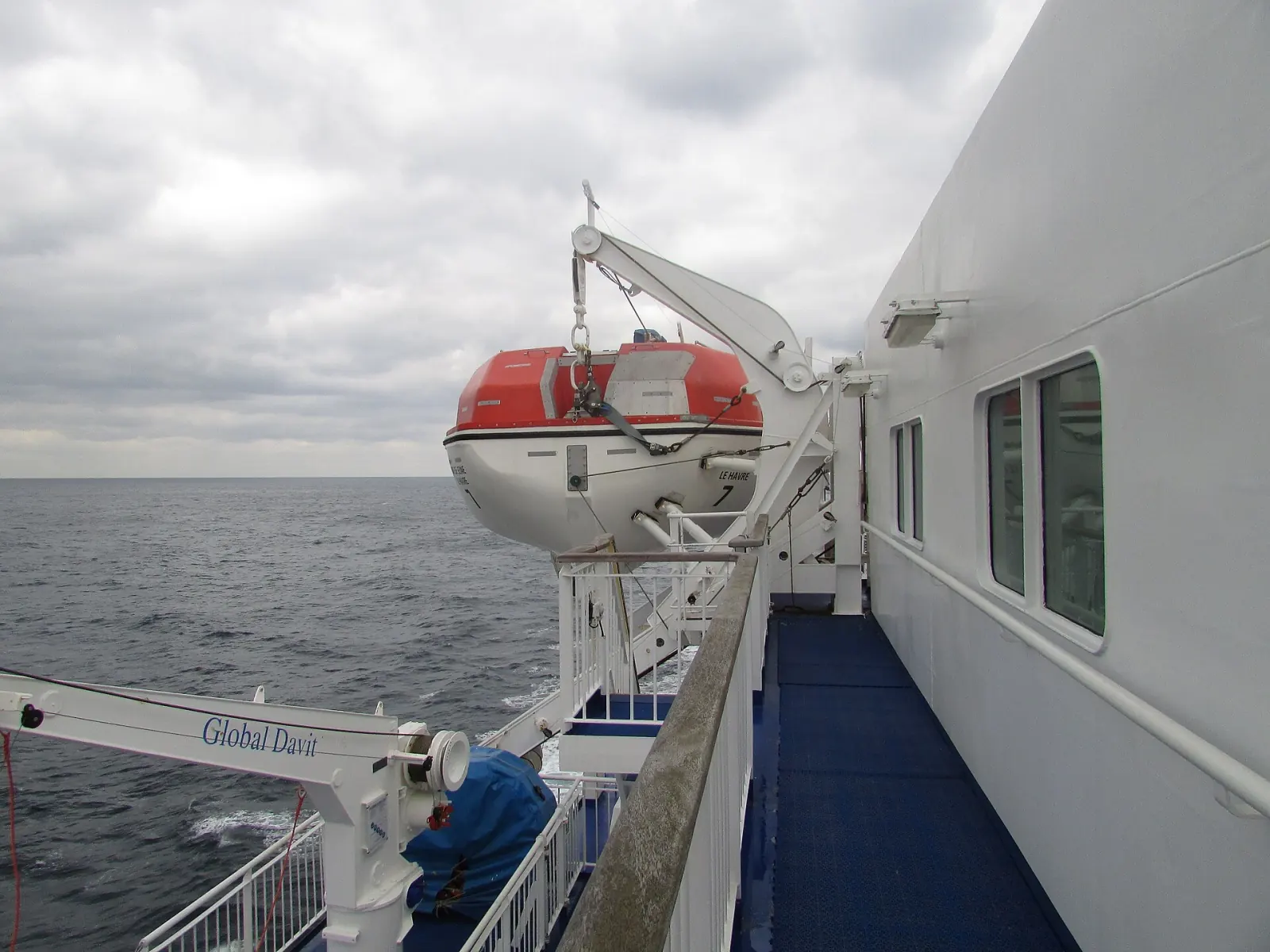
Lifeboats, davits and release gear
- Annual thorough examination of the boat, davits, winch and falls.
- Every five years: a dynamic winch-brake test and a load test of the launching appliance.
- On-load release gear overhauled at five-yearly intervals - hooks dismantled, examined and re-set, then an operational load test.
Since January 2020 this is governed by the mandatory resolution MSC.402(96), which replaced the old guidance circular. The practical change is that the servicing has to be done by the maker or a maker-authorised, certified firm, and the paperwork has to name them. A boat serviced by an unlisted contractor can be treated as not serviced at all.
EPIRBs
- Annual performance test on board, logged.
- Shore-based maintenance at intervals not exceeding five years, usually timed to the battery change.
- Battery replaced by its stamped expiry; the float-free bracket has its own HRU on a two-year cycle.
Immersion suits
Suits get an air-pressure and seam test at intervals not exceeding three years, and more often once a suit passes ten years of age. There is no fixed scrap age in the rule - it is condition-based - but a suit that fails the pressure test is done, and older suits fail more often. If your fleet has suits from the same batch, expect them to reach that point together.
Fire extinguishers and CO2
- Portable extinguishers serviced annually; hydrostatic (pressure) test of the body at intervals not exceeding ten years.
- At five-yearly intervals, at least one extinguisher of each type and year of manufacture is test-discharged - a rotating sample, not the whole rack every year.
- Fixed CO2 cylinders weighed annually and refilled if the charge drops more than ten percent; hydrostatic testing runs on a staged 10-year and 20-year schedule.
How this works with us
We don't service appliances - that stays with your approved station - but the consumables that fall due on these clocks are exactly what we keep moving: hydrostatic release units, EPIRB batteries and brackets, immersion suits, extinguisher heads and charges, liferaft spares to the maker's kit. Send the make, type and the date coming up, and the replacement is matched to the appliance and staged for the port before the certificate lapses.
Got a parts list to price?
Send it over - a binding offer within 24 hours. No obligations, the quote is free.
Send enquiry