Main and big-end bearings: clearances, wiping and the moment to renew
Main and big-end bearings run on a thin oil film and forgive a lot - until the day they do not. A wiped shell is not a defect on watch, it is a seized crankshaft and a tow. All the protection comes down to two measurements taken as routine and one limit figure from the manual. Here is how to read them.
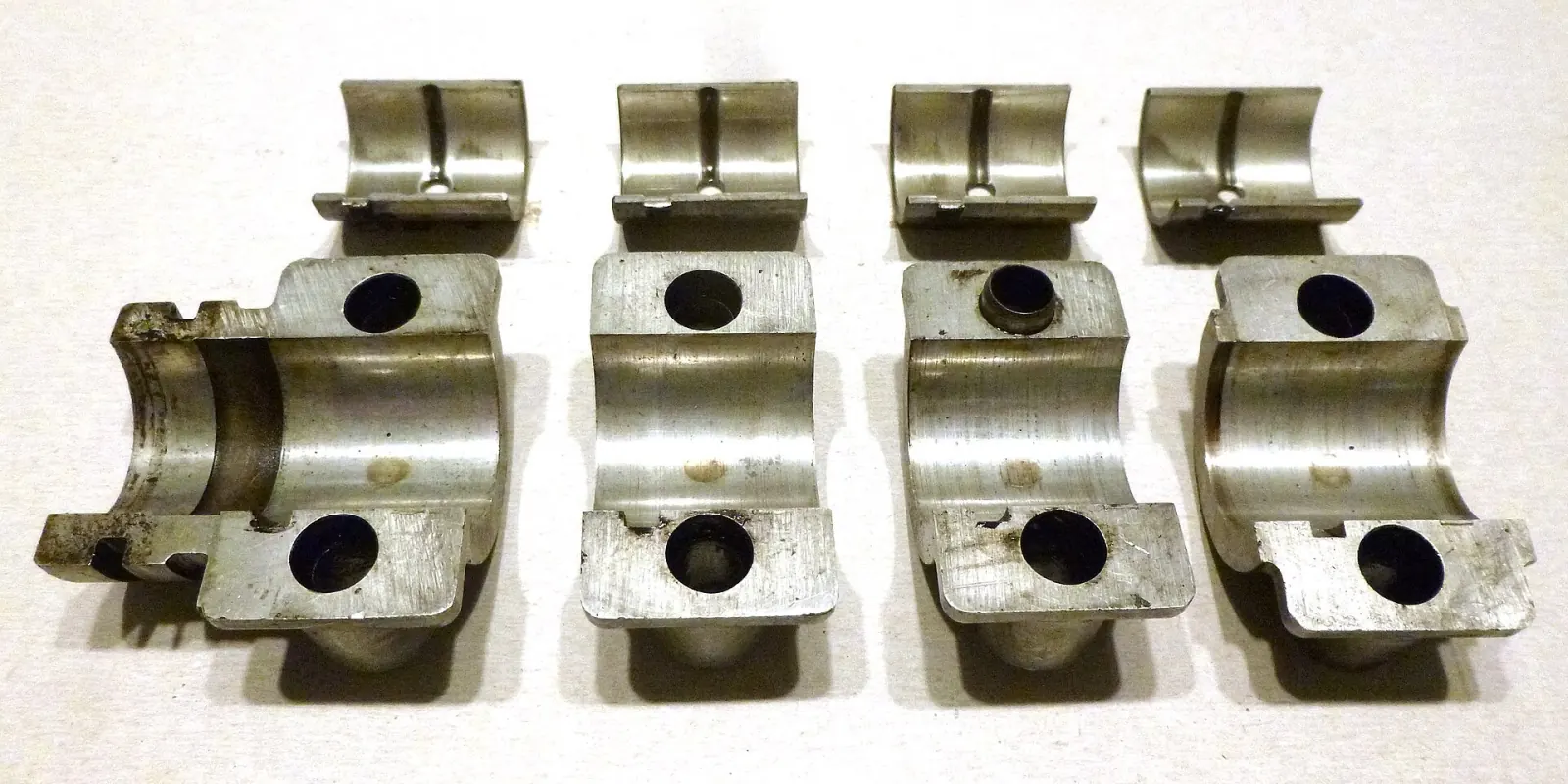
A white-metal shell has a limit
The crankshaft slide bearings are steel shells lined with white metal or a trimetal layer - deliberately a soft material, so that it wears and not the journal. Bearing clearance grows as the running layer wears. The maker gives a build clearance and a maximum; past the maximum the shell comes out even if it looks intact. You measure it with a feeler gauge, a bridge gauge, or by squeezing lead wire on assembly.
Crankshaft deflection - a measurement without a strip-down
On large engines the condition of the main bearings is read from crankshaft deflection, measured with a gauge between the webs of a throw as the shaft is turned. A spread in the readings points to a settled or worn support before the clearance goes critical. It is a routine measurement, logged and compared with previous ones - the trend means more than a single value. A deflection going out of tolerance is a signal to check the bearings, not to keep trading.
What actually finishes a bearing
- Contaminated or over-cooled oil and low lube pressure - the film breaks and the running layer wears.
- Particles in the oil embed in the soft metal and score the journal - hence the weight on filtration and regular oil analysis.
- Overload and torsional vibration wipe it locally; overheating changes the colour and structure of the white metal.
- Fatigue of the running layer after years of service - a crazing of cracks and flaking, even at a good clearance.
Undersize and selective fitting
Shells come in stages: nominal and successive undersizes for a reground journal. When you order, state the current journal size or stage, because a nominal shell on a ground shaft is a clearance out of limit from the first hour. Some engines call for selective fitting of shell thickness to a specific throw - without maker data that is a lottery. Shells are renewed in pairs per bearing, not a single half.
How this works with us
Give us the engine type, serial number and the current clearances or undersize stage, and main and big-end shells come matched to the variant and to the journal size, with material certificates and full batch traceability. Where a bearing failed because of oil or filtration, we quote the elements and system parts too, so a new shell does not repeat the story. All from the engine and propulsion catalogue.
Got a parts list to price?
Send it over - a binding offer within 24 hours. No obligations, the quote is free.
Send enquiry